Most conversations about privacy-friendly analytics focus on what you collect. But there’s a second question that’s just as important and far less discussed: where does all of it physically live? The page views, the referrers, the approximate locations — that data is stored on real servers in a real building somewhere on the planet. And which country that building sits in turns out to matter a great deal for privacy, compliance, and even how your visitors feel about being measured.
This is the topic of data residency: the geographic location where your analytics data is stored and processed. It’s not the same as choosing between self-hosting and the cloud, and it’s not about which features your tool has. It’s about jurisdiction — about whose laws apply to your visitors’ information once it’s at rest. In this guide I’ll explain why residency matters, the difference between a few terms that get muddled together, and how to find out where your own analytics data actually lives.
If you’re earlier in the journey, our overview of privacy-compliant web analytics sets the broader context this fits into.
Why the Physical Location of Data Matters
Data doesn’t live in a borderless cloud, despite the marketing language. It lives on servers in specific data centers in specific countries. And the laws of the country where data is stored — and the laws of the country where the company controlling it is headquartered — both have a say over who can access that data and under what conditions.
This is why a European site owner might care deeply whether their visitor data sits in Frankfurt or Virginia. Different jurisdictions grant different powers to governments and authorities to request access to stored data. Storing EU visitors’ data within the EU keeps it under a privacy regime designed around strong individual rights. Moving it elsewhere can expose it to legal frameworks that work very differently.
Residency is about jurisdiction, not distance. The relevant question isn’t “how far away is the server?” but “whose laws govern the data once it lands there?”
Three Terms People Mix Up
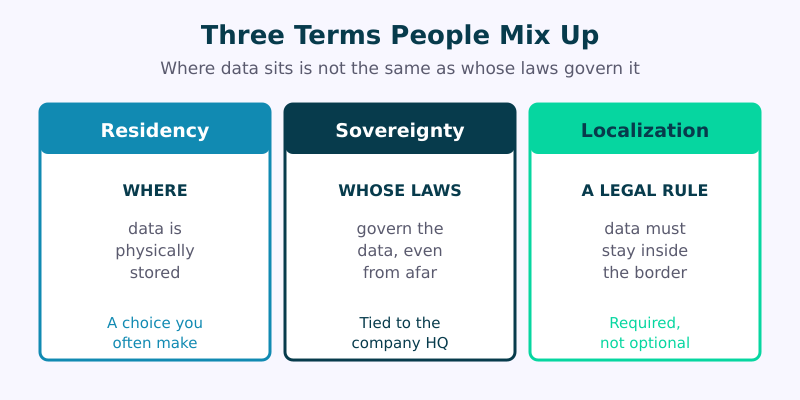
Before going further, it helps to untangle three concepts that get used interchangeably but mean different things.
Data Residency
This is simply where your data is physically stored — the country or region hosting the servers. It’s often a choice you can make: many vendors let you pick an EU region or a US region when you set up your account. Residency is the most concrete of the three.
Data Sovereignty
This goes a step further. Sovereignty is about whose laws govern the data. Data stored in one country can sometimes still be subject to the laws of another country — for example, if the company that controls it is based elsewhere. Sovereignty asks who actually holds legal authority, which isn’t always the same as where the bytes sit.
Data Localization
This is a legal requirement that certain data must stay within a country’s borders. Some jurisdictions mandate that specific categories of data — health records, financial data, government information — never leave the country. Localization is residency turned into law rather than preference.
The Cross-Border Transfer Problem
The thorniest residency issue is what happens when data crosses borders. When EU visitor data moves to a country without equivalent privacy protections, that transfer needs a legal basis to be lawful. Over the years, the mechanisms permitting EU-to-US data flows have been challenged and overturned in court more than once, leaving businesses scrambling to find a compliant footing.
A landmark EU court ruling in 2020, commonly known as Schrems II, invalidated a major framework that had been used to authorize EU-to-US data transfers, forcing companies to reassess how they move personal data across the Atlantic. Whatever the current state of the rules — and they continue to evolve — the underlying lesson holds: where you store data, and where it travels, carries real legal weight.
The cleanest way to sidestep the whole transfer question is simply not to transfer. If your visitors are European and your analytics data stays in Europe, there’s no cross-border problem to solve. This is exactly why many privacy-first vendors emphasize EU-based hosting as a default.
How Privacy-First Vendors Handle Residency
Residency is one of the areas where privacy-focused analytics tools genuinely differentiate themselves. Several of them store all data within the EU as a core promise rather than an optional setting. Others give you a region choice during setup. A few self-hosted options put residency entirely in your hands — the data lives wherever your server lives, and that’s the end of the story.
| Deployment model | Who controls residency | Typical default |
|---|---|---|
| EU-first hosted tool | The vendor (fixed) | Data stays in the EU |
| Region-selectable hosted tool | You choose at setup | Varies by selection |
| Self-hosted | You, completely | Wherever your server is |
| Legacy global tool | The vendor (often US-based) | May span multiple regions |
If residency matters to you, this is a question to settle before you commit to a tool, not after. Migrating analytics data between regions later is far more painful than choosing correctly up front. The decision interacts closely with the contract terms we cover in our piece on getting a handle on GDPR for web analytics.
How to Find Out Where Your Data Lives
- Check the vendor’s documentation. Reputable tools state their hosting regions plainly. If you can’t find it, that absence is itself a signal.
- Read the sub-processor list. Even an EU-hosted tool might use a non-EU service somewhere in its stack. The sub-processor list reveals the full geography.
- Look at the company’s headquarters. Where a company is legally based can affect which laws reach its data, even when the servers sit elsewhere — that’s the sovereignty point.
- Ask directly. A simple email asking “where is our data stored and processed?” should get a clear answer. Vagueness in reply tells you something.
- Document the answer. Record where your data lives so you can answer the question yourself if a visitor or auditor ever asks.
Frequently Asked Questions
What’s the difference between data residency and data sovereignty?
Residency is where data is physically stored — the country hosting the servers. Sovereignty is whose laws govern that data, which can differ from the storage location if the controlling company is based elsewhere. Residency is geographic; sovereignty is legal.
Why does it matter where my analytics data is stored?
The country where data is stored determines which privacy laws apply and which authorities can request access to it. For European visitors, keeping data within the EU keeps it under a privacy regime built around strong individual rights, and avoids the legal complexity of cross-border transfers.
Can I choose where my analytics data is stored?
Often, yes. Many privacy-first vendors store data in the EU by default or let you select a region during setup. Self-hosted tools give you complete control, since the data lives wherever your own server is located.
Does using a cookieless tool solve the residency question?
No — they’re separate issues. Cookieless tracking changes how data is collected; residency concerns where it’s stored afterward. A cookieless tool can still store its data in any country, so you need to check residency separately.
The Bottom Line
Where your analytics data lives is one of those questions that’s easy to overlook until a compliance review forces it into the open. But it shapes which laws protect your visitors, who can demand access to their information, and how much cross-border legal complexity you take on. The privacy-first approach is refreshingly simple here: keep the data close to the people it describes, prefer vendors that are transparent about their hosting, and treat residency as a decision to make deliberately rather than inherit by accident.
Get it right, and one more awkward question disappears — replaced by a clear, confident answer about exactly where your visitors’ data lives and why.