You’ve done the hard part. You switched to a privacy-friendly analytics tool, turned off cookies, and trimmed the data you collect down to the essentials. Then a compliance review lands on your desk asking a question you hadn’t thought about: “Where’s the Data Processing Agreement for your analytics vendor?” Suddenly the tool isn’t the only thing that matters — the contract behind it is, too.
A Data Processing Agreement, or DPA, is the legal backbone of using any third-party analytics service responsibly. It’s not glamorous, and almost nobody reads it cover to cover. But it’s the document that defines who is allowed to touch your visitors’ data, what they can do with it, and what happens when something goes wrong. In this guide I’ll demystify what a DPA actually is, why analytics tools specifically need one, and how to read the key clauses without a law degree.
This pairs naturally with our broader look at GDPR and web analytics — the DPA is one of the concrete documents that turns those obligations into practice.
What Is a Data Processing Agreement?
A DPA is a contract between two parties: the controller (you, the website owner who decides why and how data is collected) and the processor (the analytics vendor who handles that data on your behalf). The agreement spells out the rules of that relationship. It exists because, under most modern privacy laws, you can’t simply hand visitor data to a third party and wash your hands of responsibility. You remain accountable for what your vendors do with it.
Think of it like hiring a contractor to renovate your house. You’re still the homeowner, you still own the place, and you’re still responsible for what happens on the property. The contract sets out what the contractor may do, what they may not, and who’s liable if a wall comes down in the wrong spot. A DPA does the same thing for data.
Using an analytics tool without a DPA is like letting a stranger into your data without agreeing on the rules first. The tool might be perfectly trustworthy — but you have nothing in writing that says so.
Why Analytics Tools Specifically Need One
Not every service you use needs a DPA. A weather widget that never sees your visitors’ data doesn’t. But analytics is different by nature: its entire job is to receive, process, and store information about the people visiting your site. Even a minimal privacy-first tool processes things like page paths, referrers, approximate location, and device type. That’s personal data being handled by someone other than you — which is exactly the scenario a DPA is built for.
The distinction also depends on how the tool is deployed. If you self-host your analytics, you’re processing the data yourself and there may be no external processor to sign an agreement with. The moment you use a hosted service — where the vendor’s servers receive and store the data — a DPA becomes essential. Our comparison of self-hosted versus cloud analytics digs into that trade-off in detail.
The Clauses That Actually Matter
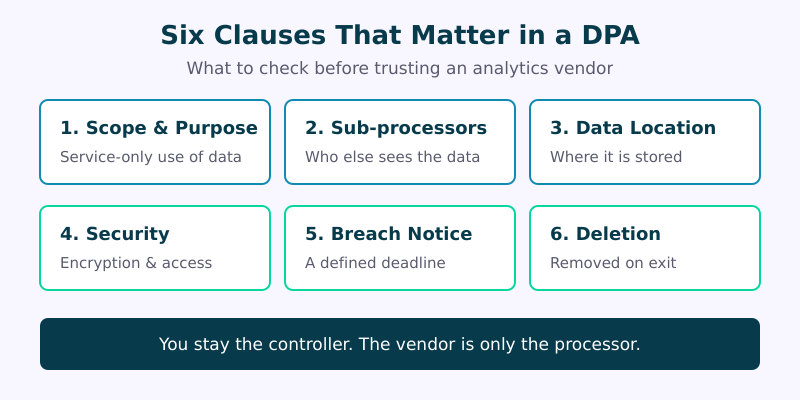
DPAs follow a fairly standard structure, which is good news: once you know what to look for, you can scan any vendor’s agreement quickly. Here are the sections worth your attention.
Scope and Purpose
This defines exactly what data is processed and why. A good clause is specific: it lists the categories of data and limits the vendor to using it only to provide the analytics service — not to build their own products or sell to third parties. Vague, open-ended purpose statements are a red flag.
Sub-processors
Almost no vendor operates entirely alone. They use hosting providers, content delivery networks, and sometimes other services. Each of these is a sub-processor that may touch your data. A solid DPA names them (or links to a maintained list) and commits to notifying you before adding new ones, so a surprise fourth party doesn’t quietly enter the picture.
Data Location and Transfers
Where does the data physically live? This clause should tell you which regions the vendor stores data in. If data leaves your jurisdiction — say, from the EU to another country — the agreement needs an appropriate legal mechanism to cover that transfer. This is where many compliance reviews focus their attention.
Security Measures
The vendor should commit to specific safeguards: encryption in transit and at rest, access controls, and so on. Look for concrete commitments rather than a one-line “we take security seriously.” The more measurable, the better.
Breach Notification
If the vendor suffers a data breach, how quickly will they tell you, and what will they tell you? Because you may have a legal deadline to notify regulators, you need the processor to alert you fast enough to meet it. Look for a defined timeframe.
Deletion and Return on Termination
When you stop using the tool, what happens to the data already collected? The agreement should commit the vendor to deleting or returning it within a stated window, rather than holding onto it indefinitely.
A Reviewer’s Quick Reference
| Clause | What good looks like | Warning sign |
|---|---|---|
| Purpose | Narrow, service-only use | Permission to use data for the vendor’s own ends |
| Sub-processors | Named list + advance notice | Silent on who else sees the data |
| Data location | Stated regions + transfer mechanism | “Servers worldwide,” no detail |
| Security | Specific, measurable safeguards | Single vague sentence |
| Breach notice | Defined deadline | “Reasonable” or unspecified |
| Deletion | Clear window after termination | No deletion commitment |
How to Actually Get a DPA in Place
The good news is that reputable analytics vendors make this easy. Most privacy-focused tools publish a standard DPA on their website that you can review and accept — sometimes with a single click in your account settings, sometimes by signing a PDF. You rarely need to negotiate custom terms unless you’re a large organization with specific requirements.
A practical sequence looks like this: confirm the vendor offers a DPA at all (a privacy-first tool that doesn’t is a serious warning sign), read the six clauses above, check the sub-processor list against your own comfort level, accept or sign it, and store a copy somewhere your compliance records live. The whole process is usually a matter of minutes, but having the document on file is what turns “we think this is fine” into “we can prove this is fine.”
Frequently Asked Questions
Do I need a DPA if my analytics tool doesn’t use cookies?
Quite possibly, yes. The DPA requirement depends on whether personal data is being processed by a third party, not on whether cookies are used. Even cookieless tools often process IP addresses, page paths, and referrers, which can qualify as personal data.
What’s the difference between a controller and a processor?
The controller decides why and how data is collected — that’s you, the site owner. The processor handles the data on the controller’s behalf following their instructions — that’s the analytics vendor. The DPA defines the rules between them.
Do I need a DPA if I self-host my analytics?
Usually not for the analytics software itself, because you’re processing the data yourself rather than sending it to a vendor. You may still need agreements with your hosting provider, though, since they handle the servers where the data lives.
Is a DPA the same as a privacy policy?
No. A privacy policy is a public notice to your visitors explaining what you do with their data. A DPA is a private contract between you and a vendor governing how that vendor handles the data. You typically need both.
The Bottom Line
A Data Processing Agreement isn’t the exciting part of building a privacy-first analytics setup, but it’s the part that holds everything together legally. The tool defines what data is collected; the DPA defines who’s accountable for it and under what rules. Choosing a privacy-friendly vendor that offers a clear, specific DPA — and actually reading the six clauses that matter — turns a good intention into a defensible position.
The next time a compliance review asks where your DPA is, you’ll be able to point to it, explain it, and move on. That’s a small amount of paperwork buying a large amount of peace of mind.