Imagine if your visitors could tell you “please don’t track me” automatically, before they even arrive — no cookie banner, no clicking, no friction. That’s not a hypothetical. It already exists, built right into browsers, in the form of opt-out signals like Global Privacy Control and the older Do Not Track header. The catch is that most websites quietly ignore them.
For anyone running a privacy-first analytics setup, these browser signals are worth understanding properly. They represent a quieter, more honest model of consent — one where respecting a person’s choice doesn’t depend on a popup they have to dismiss. In this guide I’ll explain what Global Privacy Control and Do Not Track actually are, why one largely failed while the other is gaining ground, and what honoring these signals means for the way you measure your audience.
This connects directly to our work on whether your analytics setup needs cookie consent — browser signals are part of the same conversation about respecting visitor choices.
The Idea Behind Browser-Level Opt-Out
The premise is elegant. Instead of every website asking every visitor about their preferences individually, the visitor sets their preference once, in their browser, and that preference travels with them automatically to every site they visit. One decision, universally applied. No banner fatigue, no dark patterns, no clicking “reject all” forty times a day.
Technically, this works by the browser attaching a small signal to each request. The website’s server can read that signal and adjust its behavior accordingly — for example, by not loading certain tracking, or by treating the visit as opted-out. It’s the difference between asking for permission at every door versus the visitor wearing a badge that says how they’d like to be treated everywhere.
A browser-level signal flips the consent model. Instead of the site interrupting the visitor to ask, the visitor states their choice in advance — and a respectful site simply listens.
Do Not Track: The Well-Intentioned Failure
Do Not Track, or DNT, was the first serious attempt at this idea. Introduced over a decade ago, it added a simple header to browser requests signaling “I don’t want to be tracked.” Major browsers built in a toggle for it. On paper, it should have worked beautifully.
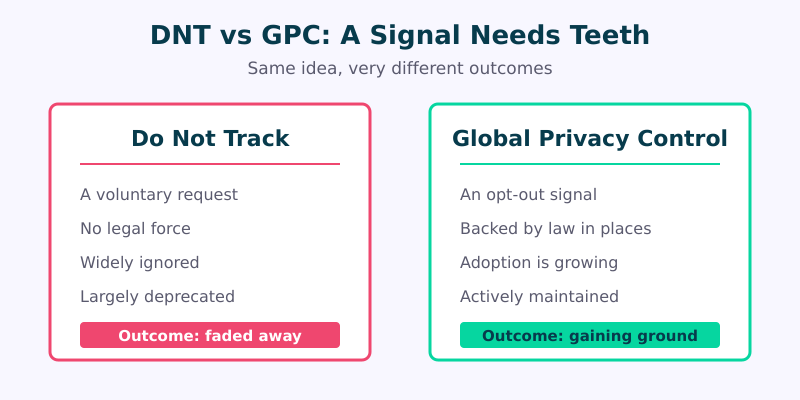
It didn’t, and the reason is instructive. DNT was a request, not a requirement. It carried no legal force, so websites were free to ignore it — and the overwhelming majority did exactly that. Without any obligation to honor the signal, advertisers and analytics platforms simply treated it as noise. Over time, browsers began quietly deprecating the feature, and DNT became a cautionary tale: a privacy signal with no teeth is just a polite suggestion nobody has to follow.
Global Privacy Control: The Signal With Teeth
Global Privacy Control, or GPC, learned from DNT’s mistakes. On the surface it looks similar — it’s another browser signal communicating a privacy preference. The crucial difference is that GPC was designed to be backed by law. In jurisdictions where it’s legally recognized, a GPC signal can carry the weight of a formal opt-out request that businesses are required to honor, not merely invited to consider.
That legal backing changes everything. When ignoring a signal can carry consequences, businesses pay attention. GPC is supported by a growing number of browsers and privacy extensions, and adoption among websites has climbed precisely because, in some places, honoring it isn’t optional. It’s the same elegant idea as DNT, but with the enforcement mechanism that DNT never had.
DNT and GPC Side by Side
| Aspect | Do Not Track (DNT) | Global Privacy Control (GPC) |
|---|---|---|
| Nature | Voluntary request | Opt-out signal with legal recognition in some regions |
| Enforcement | None | Backed by law where recognized |
| Website adoption | Very low — widely ignored | Growing |
| Current status | Largely deprecated | Actively maintained and spreading |
The contrast is the whole lesson. A privacy signal succeeds or fails not on how good the idea is, but on whether anyone is obliged to listen. GPC’s growth is a direct result of pairing a clean technical mechanism with real accountability.
What This Means for Privacy-First Analytics
Here’s the encouraging part for anyone already running privacy-friendly analytics: in many cases, you’re closer to honoring these signals than you might think. A tool that doesn’t use cookies, doesn’t build cross-site profiles, and collects only minimal aggregate data is already operating in the spirit of what GPC asks for. The signal essentially says “don’t sell or share my data and don’t track me across sites” — which is the default behavior of a well-designed privacy-first tool.
Still, it’s worth being deliberate. Consider these practices:
- Detect the signal. Your server or tag setup can read the GPC signal from incoming requests. Knowing it’s there is the first step to acting on it.
- Decide on a response. For a privacy-first tool collecting only anonymous aggregates, you might already be compliant. For anything that does build profiles or share data, honoring GPC should mean switching that off for the visitor.
- Document your approach. State in your privacy policy how you respond to browser opt-out signals. Transparency here builds genuine trust.
- Don’t punish the signal. Honoring an opt-out shouldn’t degrade the visitor’s experience. The whole point is respect without friction.
If you want to go deeper on the foundational decision of whether you even need to ask for consent in the first place, our consent decision flowchart is the right companion to this piece.
Where This Is Heading
The trajectory is clear even if the timeline isn’t. Browser-level opt-out is steadily winning out over the popup-driven model, because it’s simply better for everyone: less friction for visitors, less clutter for site owners, and a more honest expression of consent than a banner most people dismiss without reading. DNT proved the idea needed legal teeth; GPC supplied them. The direction of travel is toward signals being honored by default rather than as an exception.
For privacy-first practitioners, this is a tailwind. The web is gradually moving toward the model you’ve already chosen — one where respecting people’s choices is built into the plumbing rather than bolted on as an afterthought.
Frequently Asked Questions
What is the difference between Do Not Track and Global Privacy Control?
Both are browser signals expressing a privacy preference. Do Not Track was a voluntary request with no legal force, so most websites ignored it and browsers eventually deprecated it. Global Privacy Control is designed to be legally recognized in some jurisdictions, meaning businesses there may be required to honor it.
Do I have to honor a Global Privacy Control signal?
It depends on your jurisdiction and the nature of your data processing. In regions where GPC is legally recognized as an opt-out mechanism, honoring it can be a requirement. Even where it isn’t strictly required, respecting it is good practice and aligns with a privacy-first approach.
Is my privacy-first analytics tool already compliant with these signals?
Often it’s close. A tool that uses no cookies, builds no cross-site profiles, and collects only anonymous aggregates already behaves in line with what these signals ask for. It’s still worth confirming how your specific setup detects and responds to the signal.
Why did Do Not Track fail?
Because it had no enforcement behind it. DNT was purely a request that websites were free to ignore, and most did. Without any obligation to honor the signal, it became background noise — which is exactly the gap Global Privacy Control was created to close.
The Bottom Line
Browser-level opt-out signals tell the story of privacy on the web in miniature. Do Not Track had the right idea but no power to enforce it, and it withered. Global Privacy Control took the same idea, gave it legal weight, and is steadily gaining ground. For anyone committed to measuring their audience respectfully, these signals aren’t a threat — they’re a confirmation that the web is moving toward the very principles privacy-first analytics has championed all along.
Listen for the signal, respond to it honestly, and tell your visitors how you do. That’s the whole of it — consent without the drama.