Last updated: February 2026
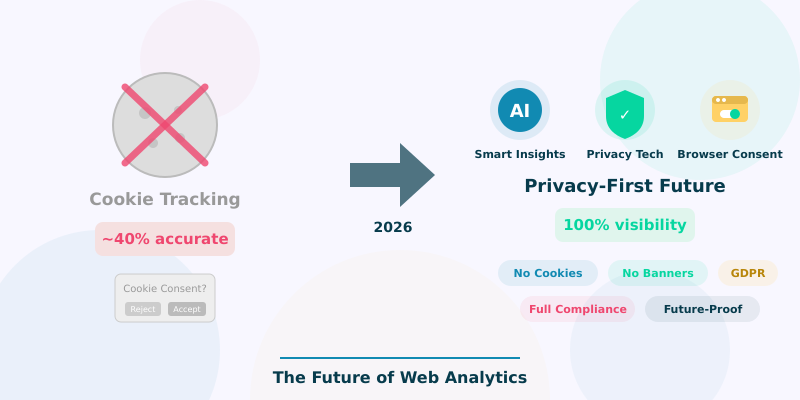
The web analytics industry is in the middle of its biggest transformation since Google Analytics launched in 2005. Third-party cookies are dying. Privacy regulations are multiplying. AI is rewriting what analytics tools can do — and what they’re allowed to do. And the browser itself is becoming the new gatekeeper of user consent.
If you’re still thinking about analytics as “install a tracking script and check your dashboard,” you’re about to be blindsided. The next generation of web analytics looks nothing like what came before. This guide maps out where the industry is heading, what technologies are reshaping measurement, and what you should be doing now to stay ahead.
This is part of our content series alongside the Complete Guide to Privacy-Compliant Analytics and the Google Analytics Alternatives Buyer’s Guide.
The Analytics Landscape Is Shifting
Three forces are converging to reshape web analytics simultaneously — and their interaction creates a landscape that’s fundamentally different from anything we’ve seen before.
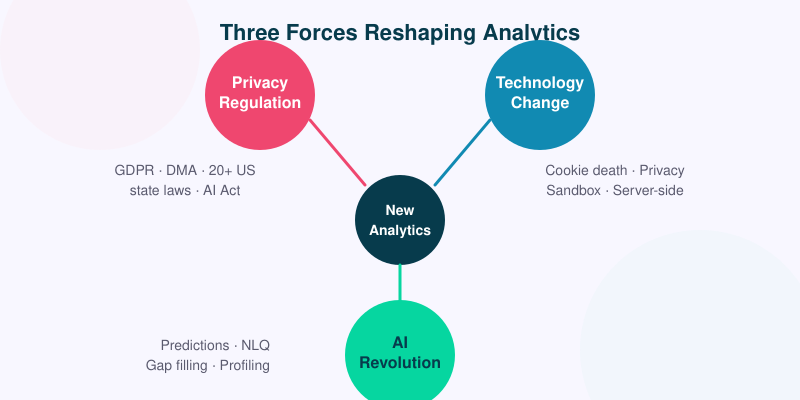
Force 1: Privacy regulation is accelerating. The GDPR set the template, but 2025-2026 brought an explosion of enforcement. CNIL issued €475 million in cookie fines in 2025 alone. The ICO audited the UK’s top 1,000 websites. Over 20 US states now have privacy laws. The EU’s Digital Omnibus Package proposes merging cookie rules directly into GDPR. Every new regulation makes traditional tracking harder.
Force 2: The technical foundation is changing. Safari and Firefox already block third-party cookies. Google’s Privacy Sandbox — its six-year effort to replace cookies in Chrome — was officially retired in October 2025, and Google quietly reversed course on fingerprinting the same year. Safari, Firefox, and Brave together affect 20-25% of website visitors with tracking restrictions. Server-side tracking is growing — 89% of financial services and 78% of e-commerce companies now use it — but it brings its own compliance challenges. The old model of “drop a cookie, track everything” is over.
Force 3: AI is rewriting the rules. Machine learning can now fill gaps left by lost cookie data, predict user behavior from aggregate patterns, and automate insights that previously required analyst teams. But AI in analytics also raises new privacy questions — the EU AI Act specifically targets automated profiling and prediction systems.
The winners in this new landscape will be tools and strategies that work with these forces rather than against them. Here’s what that looks like.
AI-Powered Analytics: Hype vs Reality
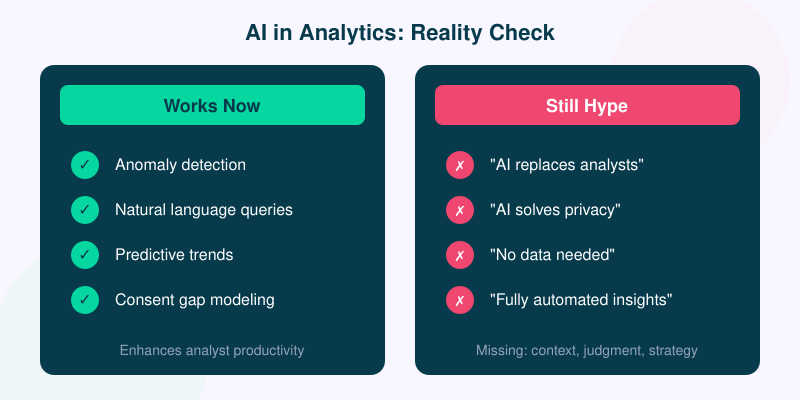
Every analytics vendor now claims AI capabilities. But there’s a massive gap between marketing claims and practical value. Here’s what AI actually changes for web analytics — and what’s still hype.
What AI Actually Does Well
Anomaly detection. ML models excel at spotting unusual patterns in traffic data — sudden drops, unexpected spikes, bot traffic. Matomo 5.6 introduced AI-powered bot detection and AI Agent tracking that separates visits from ChatGPT, Claude, and other AI agents from human traffic. PostHog’s Max AI assistant automates insights and generates SQL queries from natural language questions.
Natural language queries. Instead of building complex report filters, you can ask “What was my top traffic source last Tuesday?” and get an answer. GA4 now integrates with Google’s Gemini AI, PostHog’s Max AI generates SQL from plain English, and Plausible supports AI agent integrations via MCP (Model Context Protocol). It’s genuinely useful for non-technical users.
Predictive analytics. Given enough aggregate data, ML models can predict trends — likely churn, conversion probability, seasonal patterns. GA4’s predictive audiences and PostHog’s correlation analysis are practical examples. The catch: these work best with large datasets, which privacy-first tools intentionally don’t collect.
Data gap filling. When consent rejection means you only see 30-40% of your traffic, AI can model the missing data using statistical techniques. Google’s consent mode “behavioral modeling” does exactly this — though its accuracy is debated and the methodology isn’t transparent. Use our Consent Impact Dashboard to quantify the exact data gap for your site before deciding whether AI modeling is worth the trade-offs.
What’s Still Hype
“AI replaces analysts.” Current AI is good at pattern recognition and data retrieval, but terrible at understanding business context, asking the right questions, or knowing which metrics actually matter for your specific situation. AI assists analysts — it doesn’t replace them.
“AI solves privacy.” Some vendors claim AI can give you the same insights without collecting personal data. In reality, if the AI needs personal data to train, you still have a privacy problem. Only AI trained on genuinely aggregate, anonymized data qualifies as privacy-enhancing.
Privacy-Enhancing Technologies (PETs)
Privacy-enhancing technologies are the most important trend in analytics that most marketers have never heard of. PETs are technologies that enable data analysis without exposing individual-level data — and they’re growing fast.
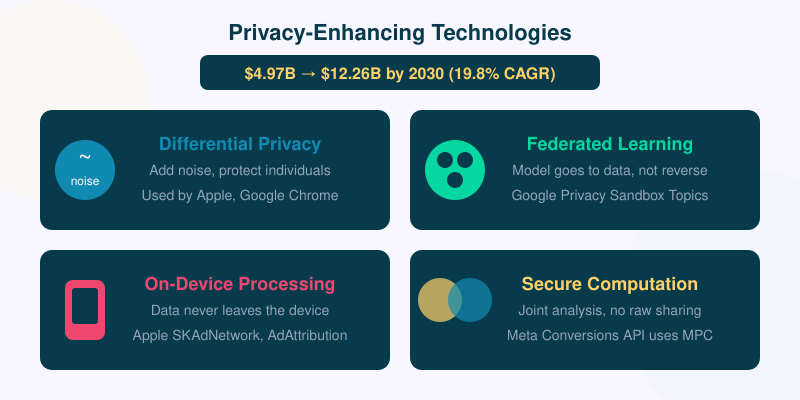
The global PET market is projected to grow from $4.97 billion (2025) to $12.26 billion by 2030 — a 19.8% compound annual growth rate, according to Mordor Intelligence. That’s not a niche — it’s a fundamental infrastructure shift.
Key Technologies
Differential privacy adds mathematical noise to datasets so that individual records can’t be identified, while aggregate statistics remain accurate. Apple uses differential privacy in Safari and iOS analytics. Google uses it in Chrome usage reporting. It’s the gold standard for statistical privacy — and it’s coming to marketing analytics tools.
Federated learning trains ML models across distributed devices without centralizing data. Instead of sending your browsing data to a server, the model comes to your device, learns locally, and only sends back aggregated model updates. In healthcare, federated learning combined with differential privacy achieves over 96% accuracy in medical imaging while keeping patient records private — a model the analytics industry is watching closely.
On-device processing keeps analytics computation on the user’s device entirely. Apple’s SKAdNetwork and the newer AdAttributionKit process ad attribution on-device, sending only aggregate results to advertisers. This is the most privacy-preserving approach — no personal data ever leaves the device.
Secure multi-party computation (MPC) allows multiple parties to jointly compute analytics without any party seeing the other’s raw data. Meta’s Conversions API uses MPC for privacy-preserving ad measurement. It’s complex to implement but powerful for cross-platform measurement.
The Post-Cookie Stack
The third-party cookie is dead — or at least terminally ill. Here’s what’s replacing it and what it means for your analytics setup.
Where Cookies Stand Now
Safari (WebKit): Third-party cookies have been fully blocked since 2020 via Intelligent Tracking Prevention (ITP). First-party cookies are capped at 7 days for JavaScript-set cookies, 24 hours if the referrer is a known tracker.
Firefox: Total Cookie Protection (TCP) isolates cookies per site since 2022. Third-party cookies exist but can’t track across sites.
Chrome: Google’s plan to deprecate third-party cookies was the longest-running saga in adtech — and it ended with a reversal. After six years of promises, Google officially retired the Privacy Sandbox in October 2025, citing low adoption. Chrome will continue supporting third-party cookies without restriction. Worse, in February 2025, Google gave advertisers the go-ahead to use digital fingerprinting — a technique Google itself called “wrong” in 2019. The UK’s ICO labeled this reversal “irresponsible.”
Brave, Arc, Vivaldi: All block third-party cookies and most trackers by default. Their combined market share is small but growing among privacy-conscious users — exactly the audience you’re most likely to lose with traditional tracking.
The New Stack
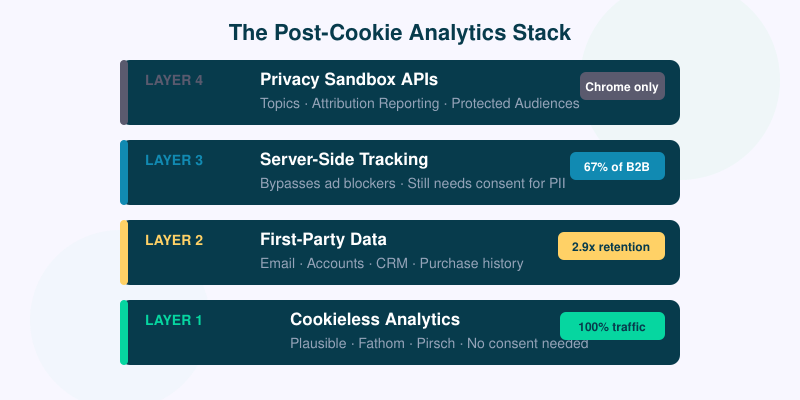
Layer 1: Cookieless analytics — Tools like Plausible, Fathom, and Pirsch that work without any cookies. They see 100% of traffic, require no consent banners, and are immune to cookie deprecation. This is your foundation. See our complete alternatives guide for options.
Layer 2: First-party data — Email signups, account data, purchase history, CRM data. This is data users give you directly and knowingly. It’s the highest-quality data source and fully compliant when collected with proper consent. Companies using first-party data achieve 2.9x better customer retention according to industry research.
Layer 3: Server-side tracking — Moving tracking logic from the browser to your server. This bypasses ad blockers and browser restrictions but doesn’t bypass privacy laws. According to the JENTIS Server-Side Tracking Report 2026, financial services lead adoption at 89%, followed by e-commerce at 78%. Most online stores lose 30-40% of conversion data with client-side tracking alone. If you go this route, you still need consent for personal data collection.
Layer 4: Platform conversion APIs — With Google’s Privacy Sandbox retired, the industry has coalesced around server-to-server conversion APIs: Meta’s Conversions API (CAPI), Google’s Enhanced Conversions, and TikTok’s Events API. Meta reports advertisers using CAPI see approximately +20% additional conversions recovered compared to pixel-only tracking. These are platform-specific and require handling hashed personal data (usually emails).
Data Clean Rooms for Marketers
Data clean rooms are secure environments where multiple parties can combine and analyze data without either party seeing the other’s raw records. The market is valued at $1.25 billion (2024) and projected to reach $2.7 billion by 2032. Close to 66% of organizations now use clean rooms in some capacity.
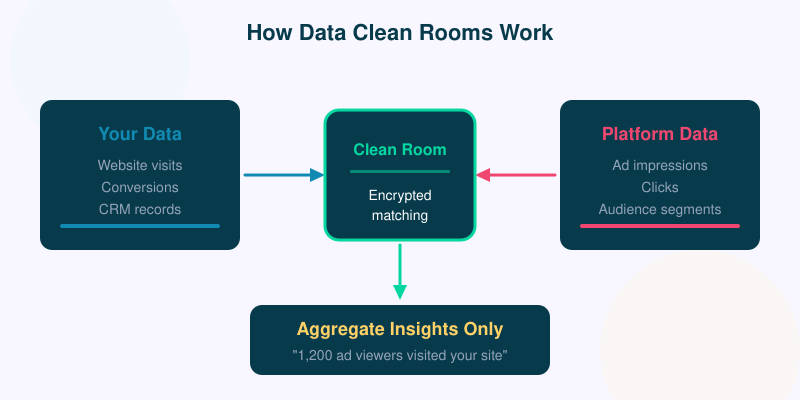
How they work: Imagine you want to know how many people who saw your YouTube ad later visited your website. In the old world, you’d use cookies to track them across both platforms. In a clean room, YouTube and your website each contribute encrypted data. A matching algorithm finds overlaps without revealing individual identities. You get aggregate statistics — “1,200 ad viewers visited your site” — without either party exposing raw user data.
Major Providers
Google Ads Data Hub — analyze Google campaign data joined with your first-party data. Limited to Google’s ecosystem but powerful for Google advertisers.
AWS Clean Rooms — Amazon’s platform-agnostic clean room on AWS infrastructure. Supports custom SQL queries with cryptographic access controls.
Snowflake Data Clean Rooms — built into Snowflake’s data cloud. Popular with enterprises already using Snowflake for their data warehouse.
LiveRamp, InfoSum, Habu — specialized clean room providers focused on advertising measurement and audience matching.
Who needs this? Clean rooms are primarily for mid-to-large enterprises running cross-platform advertising. If you’re a small business or blog, cookieless analytics and first-party data cover your needs. Clean rooms solve the specific problem of privacy-compliant advertising measurement at scale.
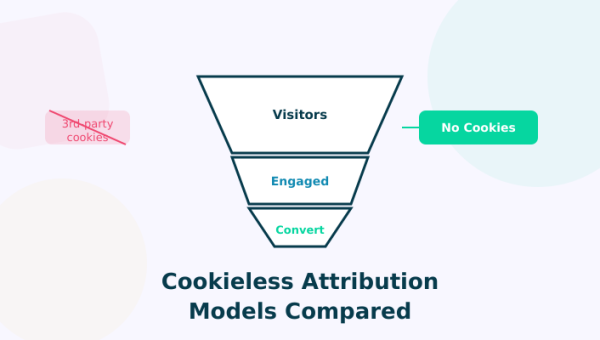
Cookieless Attribution Models
Attribution — figuring out which marketing touchpoint drove a conversion — has been built on cookies for two decades. With cookies disappearing, the entire attribution industry is reinventing itself.
What’s Replacing Cookie-Based Attribution
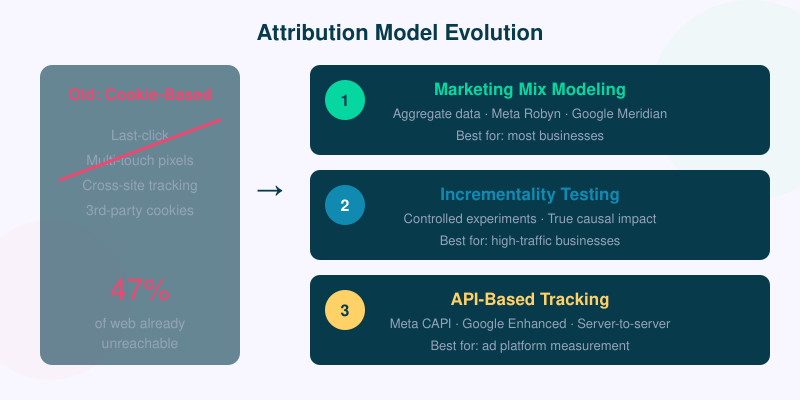
Marketing Mix Modeling (MMM) is back — and booming. According to EMARKETER, 46.9% of US marketers plan to invest more in MMM over the next year, with interest up 300% since 2023. This decades-old statistical technique uses aggregate data (spend, impressions, revenue) to estimate each channel’s contribution — no cookies needed. Meta’s Robyn (open-source MMM) and Google’s Meridian have made MMM accessible to mid-size companies, not just enterprises with data science teams.
Incrementality testing measures the true causal impact of marketing by running controlled experiments — showing ads to one group, withholding from another, and measuring the difference. 52% of US brand and agency marketers already use incrementality testing. It’s the most scientifically rigorous approach to attribution and doesn’t require any user-level tracking. The downside: it requires significant traffic volume and careful experiment design. The emerging best practice is a “triangulation” approach: MMM for strategic allocation, attribution for tactical optimization, and incrementality for causal validation.
API-based conversion tracking — platforms like Meta (Conversions API), Google (Enhanced Conversions), and TikTok (Events API) now offer server-to-server conversion reporting. You send conversion data from your server to the ad platform’s server, bypassing the browser entirely. This is more reliable than pixel-based tracking but still requires handling personal data (usually hashed emails). For simpler campaign measurement, properly structured UTM parameters remain the most privacy-friendly attribution method available.
Probabilistic attribution uses statistical modeling to estimate conversion paths without deterministic user IDs. It’s less accurate than cookie-based tracking but works across all browsers and devices. Several analytics platforms now offer this as a feature.
Browser-Level Consent: The End of Banners
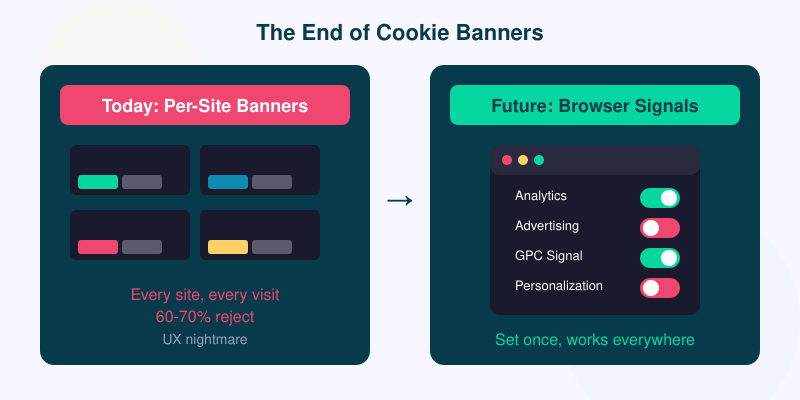
Cookie consent banners are one of the most hated features of the modern web. They’re ugly, they interrupt the user experience, and research shows most people click through without reading them. Until browser signals are universal, tools like our Consent Banner Generator and Consent Logic Planner help you implement compliant banners with minimal friction. The future is browser-level consent — and it’s closer than you think.
Global Privacy Control (GPC)
GPC is a browser signal that communicates “do not sell or share my personal data.” Unlike the old Do Not Track (DNT) signal, which was legally unenforceable and universally ignored, GPC has real legal teeth. As of January 2026, twelve US states legally require businesses to honor GPC — including California, Colorado, Connecticut, Montana, Nebraska, New Hampshire, New Jersey, Minnesota, Maryland, Delaware, Oregon, and Texas. Enforcement is real: Tractor Supply paid $1.35 million in September 2025 for failing to honor GPC signals — the largest CPPA fine in history.
GPC is already built into Firefox, Brave, and DuckDuckGo browser. Chrome supports it via extensions. When a user enables GPC, every website they visit automatically receives the opt-out signal — no per-site banner interaction needed.
California’s AB 566: Browsers Must Include Opt-Out
In October 2025, California Governor Newsom signed AB 566 — the “Opt Me Out” Act. It makes California the first state to require all browsers to include built-in opt-out preference signal functionality by January 1, 2027. This means Chrome, Safari, Edge, and every other browser operating in California must offer easy-to-use opt-out signals. The obligation to honor those signals falls on businesses — browser developers get immunity.
W3C Privacy Proposals
The W3C’s Privacy Community Group is working on broader consent signal standards that could eventually replace cookie banners entirely. The vision: users set their privacy preferences once in their browser settings (“I accept analytics but not advertising tracking”), and websites automatically respect those preferences. No banners, no popups, no friction.
This is still in early stages, but the direction is clear. Both the EU Digital Omnibus Package and the UK’s Data (Use and Access) Act reference browser-level consent as a future mechanism.
What This Means
When browser-level consent becomes standard, the analytics landscape splits definitively:
- Cookieless analytics (Plausible, Fathom, etc.) continue working with zero friction — they never needed consent in the first place
- Cookie-based analytics (GA4 without consent mode) see traffic data only from users who’ve set their browser to “accept analytics” — likely a minority
- Consent-dependent tools face an existential problem: if the browser handles consent, there’s no banner to configure, and opt-in rates may be even lower than current 25-40%
What You Should Do Now
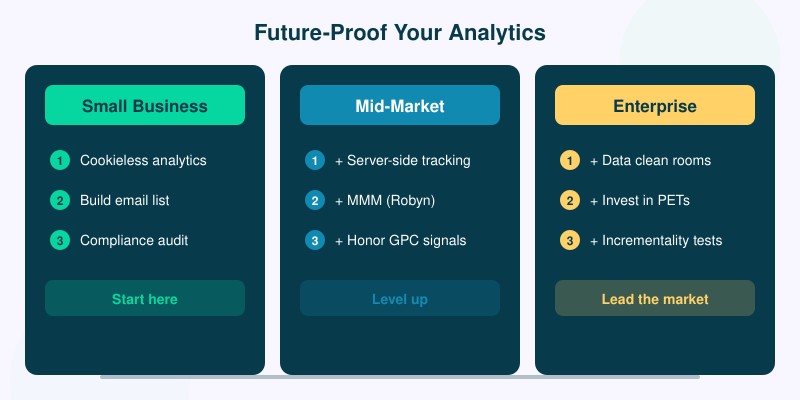
The future is complex, but the actions you should take today are straightforward. Here’s a practical roadmap based on company size.
Everyone (Any Size)
- Switch to cookieless analytics as your primary measurement tool. This is the single most impactful step. See our Plausible vs Fathom vs Matomo comparison to choose.
- Build first-party data assets. Email lists, user accounts, direct relationships. This data appreciates in value as third-party data becomes harder to access.
- Audit your current stack for privacy compliance. Use our compliance guide as a checklist.
Mid-Market Companies
- Implement server-side tracking for advertising platforms (Meta CAPI, Google Enhanced Conversions) alongside your cookieless analytics.
- Explore Marketing Mix Modeling. Tools like Meta’s Robyn make MMM accessible without a full data science team.
- Honor GPC signals and prepare for browser-level consent by reducing your dependency on cookie-based tracking.
Enterprise
- Evaluate data clean rooms for cross-platform advertising measurement.
- Invest in PETs. Differential privacy and federated learning will become standard requirements — getting ahead now builds competitive advantage.
- Run incrementality tests to understand true marketing ROI without relying on attribution models.
- Monitor the EU AI Act for compliance requirements around AI-powered analytics and automated profiling.
FAQ
Are third-party cookies really going away?
They’re already gone in Safari and Firefox. And Google’s six-year Privacy Sandbox effort to replace cookies in Chrome was officially retired in October 2025 — Chrome will keep supporting third-party cookies. But that doesn’t mean cookies are healthy: Safari, Firefox, and Brave together affect 20-25% of visitors, ad blockers strip tracking from another large chunk, and 38% of US consumers now accept cookies less often than three years ago. Cookies still work in Chrome, but the data they provide is increasingly incomplete.
Will AI replace web analytics tools?
No. AI enhances analytics tools with better anomaly detection, natural language queries, and predictive modeling — but it doesn’t replace the need for data collection, dashboards, and human interpretation. The most useful AI features are already being built into existing tools like PostHog, GA4, and Matomo.
What are Privacy-Enhancing Technologies (PETs)?
PETs are technologies that enable data analysis without exposing individual-level data. Key examples: differential privacy (adding noise to protect individuals), federated learning (training models without centralizing data), on-device processing (keeping data on the user’s device), and secure multi-party computation (combining data from multiple parties without sharing raw records). The PET market is projected to reach $12.26 billion by 2030.
Do I need a data clean room?
Only if you’re running cross-platform advertising at significant scale and need to measure overlap between platforms (e.g., YouTube ad viewers who convert on your website). For most small and mid-size businesses, cookieless analytics plus first-party data provides everything you need.
What’s the best cookieless attribution model?
It depends on your scale. For most businesses, Marketing Mix Modeling (MMM) using tools like Meta’s Robyn or Google’s Meridian is the most practical starting point. For larger businesses with enough traffic, incrementality testing gives the most accurate results. API-based conversion tracking (Meta CAPI, Google Enhanced Conversions) is useful for advertising platform-specific measurement.
When will cookie consent banners disappear?
Not immediately, but the trajectory is clear. Global Privacy Control (GPC) already has legal backing in California and several other US states. The EU Digital Omnibus Package and UK’s Data (Use and Access) Act both reference browser-level consent mechanisms. Realistically, expect a 3-5 year transition where banners coexist with browser signals before banners become obsolete for privacy-conscious sites — or immediately, if you switch to cookieless analytics that don’t need banners at all.
How does the EU AI Act affect analytics?
The AI Act becomes fully applicable on August 2, 2026, establishing risk-based obligations for AI systems. If your analytics tool uses AI to profile users, predict behavior, or make automated decisions, you may need to provide transparency explanations and allow users to contest those decisions. Gartner predicts 40% of AI data breaches will arise from cross-border GenAI misuse by 2027. Analytics tools that work with aggregate data only (no individual profiling) are less affected.
The future of web analytics isn’t about finding clever ways to track people without their knowledge. It’s about building measurement systems that work because they respect privacy — not in spite of it. The tools and technologies described in this guide make that possible today. The question isn’t whether to adapt, but how quickly.
Ready to start? Begin with our Google Analytics Alternatives Buyer’s Guide, ensure your setup meets the standards in our Privacy-Compliant Analytics Guide, and come back here when you need to plan your next move.