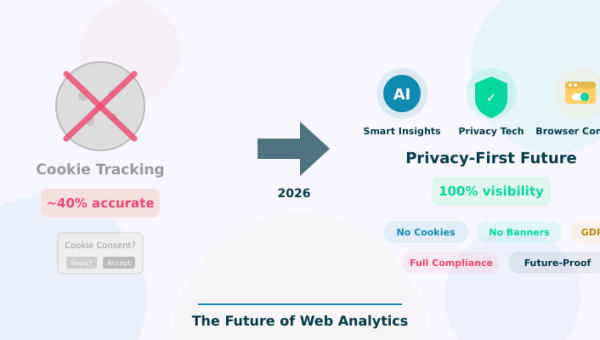
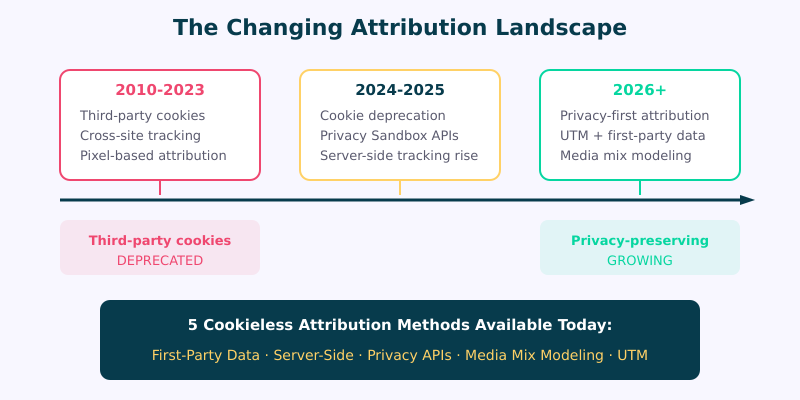
If you’re still relying on third-party cookies for attribution, I have some uncomfortable news: that ship has sailed. Chrome finally deprecated third-party cookies in 2025, joining Safari and Firefox which blocked tracking cookies years earlier. The entire attribution landscape has shifted — and honestly, it’s about time.
But here’s the thing most marketers miss: cookieless attribution isn’t a downgrade. It’s a different approach, and in many cases, a better one. You trade granular user-level stalking for models that actually respect people’s privacy while still giving you actionable data.
In this deep dive, I’ll walk you through the five main cookieless attribution models available in 2026, compare them head-to-head, and help you figure out which one fits your situation. This article is part of my broader series on the future of web analytics — if you haven’t read the hub piece yet, start there for the full picture.
Why Cookie-Based Attribution Is Dying
Let’s be clear about what happened. Cookie-based attribution didn’t just get a little harder — it became fundamentally broken across most of the web.
Safari’s Intelligent Tracking Prevention (ITP) started capping cookie lifetimes back in 2017. Firefox Enhanced Tracking Protection (ETP) followed. And when Chrome finally pulled the plug on third-party cookies in 2025, it eliminated the last major holdout. That means cross-site tracking via cookies is effectively dead on every major browser.
The numbers tell the story. Third-party cookie-based attribution now misses 60-80% of user journeys depending on your audience’s browser mix. If you’re still running multi-touch attribution models built on cookie data, you’re making decisions based on a fraction of reality.
But the shift isn’t just technical — it’s regulatory. GDPR, ePrivacy Directive, CCPA, and a growing wave of state-level privacy laws have made cookie consent a legal minefield. Even where cookies technically work, consent rates for tracking cookies hover around 30-40% in the EU. Our Consent Impact Dashboard models this data gap precisely. That’s a massive hole no attribution model can paper over.
The industry needed alternatives. And we got them — five major ones, each with different tradeoffs.
First-Party Data Attribution
First-party data attribution is the most straightforward replacement for cookie-based tracking. Instead of relying on third-party cookies that follow users across sites, you use data collected directly from your own domain — login states, purchase history, email interactions, CRM records.
Here’s why I recommend this as a starting point for most businesses: you already have the data. Every time someone creates an account, subscribes to your newsletter, or makes a purchase, you’re building a first-party dataset that’s both privacy-compliant and highly accurate.
The key tools in this space include Customer Data Platforms (CDPs) like Segment, privacy-focused analytics platforms like Plausible and Fathom (which use first-party data exclusively), and your own CRM. The trick is connecting touchpoints through authenticated sessions rather than tracking pixels.
Strengths: High accuracy for known users, fully privacy-compliant, you own the data. Weaknesses: Only works for users who identify themselves, limited cross-device capability without additional signals. For a deeper look at protecting the data you collect, check out my guide on privacy-enhancing technologies.
Server-Side Attribution
Server-side attribution moves tracking from the browser to your server. Instead of JavaScript tags firing in the user’s browser (where ad blockers and cookie restrictions live), conversion data flows from your server to the ad platform’s server.
The three big implementations in 2026 are Google Tag Manager Server-Side, Meta’s Conversions API (CAPI), and TikTok’s Events API. Each lets you send conversion events directly from your backend without relying on browser-side cookies or pixels.
I’ve seen server-side setups recover 20-40% of conversions that client-side tracking misses. That’s significant. But — and this is important — server-side tracking doesn’t automatically mean privacy-friendly. You’re still sending user data to ad platforms. The difference is reliability, not necessarily privacy.
To make server-side attribution genuinely privacy-respecting, you need to hash personally identifiable information before transmission, implement proper consent management, and strip unnecessary data fields. Done right, it’s a powerful tool. Done carelessly, it’s just a more reliable way to violate people’s privacy.
Strengths: Bypasses browser restrictions, recovers lost conversions, more reliable data flow. Weaknesses: Higher technical complexity, requires server infrastructure, still sends data to third parties.
Privacy-Preserving APIs
Google’s Privacy Sandbox introduced two APIs that are reshaping attribution: the Topics API and the Attribution Reporting API.
The Topics API replaces interest-based audience targeting. Instead of tracking users across sites, the browser itself categorizes the user’s interests based on browsing history, then shares a limited set of topics with advertisers. No individual tracking, no cross-site cookies — just broad interest signals processed locally on the device.
The Attribution Reporting API is more directly relevant to our discussion. It lets advertisers measure whether an ad click or view led to a conversion, but with built-in privacy protections: noise is added to the data, reports are delayed, and the granularity is deliberately limited. You get aggregate-level insight without user-level tracking.
In practice, I find these APIs most useful for larger advertisers running significant paid campaigns. If you’re spending $50K+ monthly on Google Ads, the Attribution Reporting API gives you meaningful signal. For smaller operations, the noise added to reports can make the data less actionable.
Strengths: Built into Chrome, privacy by design, no consent required for aggregated data. Weaknesses: Chrome-only (for now), deliberately noisy data, limited to ad-driven attribution, still evolving.
Media Mix Modeling (MMM)
Media Mix Modeling is the oldest approach on this list — it predates digital advertising entirely — and it’s making a massive comeback. MMM uses statistical analysis to determine how different marketing channels contribute to outcomes, without requiring any user-level data at all.
The concept is straightforward: you feed historical data about your marketing spend across channels, along with business outcomes (revenue, leads, sign-ups), into a statistical model. The model identifies correlations and estimates each channel’s contribution. No cookies, no pixels, no tracking — just math.
Meta’s open-source Robyn and Google’s Meridian have made MMM accessible to mid-size businesses for the first time. What used to require a team of data scientists and six-figure budgets can now be implemented by a competent analyst with Python or R skills.
I’m particularly bullish on MMM for 2026 because it’s fundamentally future-proof. No matter what happens with browser APIs, privacy regulations, or consent frameworks, MMM keeps working. It answers the question “which channels drive results?” without ever needing to know who clicked what.
Strengths: Zero user-level data needed, regulatory-proof, works across all channels including offline. Weaknesses: Requires historical data (6-12 months minimum), less granular than user-level attribution, can’t optimize individual campaigns in real-time.
UTM-Based Attribution
Sometimes the simplest solution is the best one. UTM parameters — those tags you append to URLs — remain the most universal attribution method available. They work with every analytics tool, require no special infrastructure, and don’t depend on cookies or browser APIs.
When a user clicks a link with UTM parameters, your analytics tool captures the source, medium, campaign, and content directly from the URL. It’s first-party data by nature. Plausible, Fathom, Matomo, Simple Analytics, and yes, even GA4 — they all support UTM tracking out of the box.
The limitations are real: UTM parameters only track the click, not subsequent behavior across sessions (unless combined with first-party data). They’re also prone to human error — inconsistent naming conventions can turn your data into chaos (a UTM builder tool helps enforce consistency). And they don’t work for organic or direct traffic at all.
But for campaign attribution specifically, UTMs are bulletproof. I use them as the foundation layer in every attribution stack I build. For a complete walkthrough on building a privacy-compliant measurement framework that includes UTM best practices, see my privacy-compliant analytics guide.
Strengths: Universal compatibility, zero technical complexity, inherently privacy-friendly. Weaknesses: Click-level only, no cross-session tracking, requires disciplined naming conventions.
Which Model Fits Your Needs?
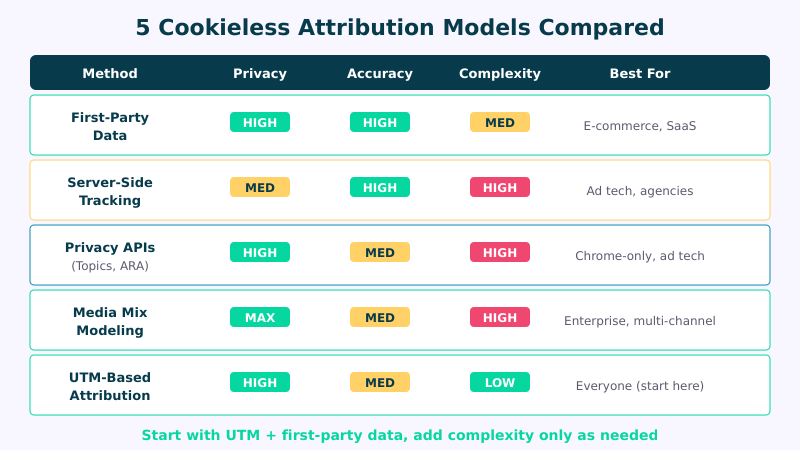
Let me cut through the complexity with a direct comparison. Here’s how the five models stack up across the dimensions that actually matter:
| Method | Privacy Level | Accuracy | Complexity | Cost |
|---|---|---|---|---|
| First-Party Data | High | High (known users) | Medium | Medium |
| Server-Side | Medium | High | High | High |
| Privacy-Preserving APIs | High | Medium | Medium | Low |
| Media Mix Modeling | Very High | Medium | High | Medium-High |
| UTM Parameters | Very High | Medium (clicks only) | Low | Free |
My practical recommendation based on business size:
- Small businesses and blogs: UTM parameters + a privacy-focused analytics tool like Plausible or Fathom. Simple, effective, and you’ll sleep well at night.
- Mid-size e-commerce and SaaS: First-party data attribution as your foundation, UTMs for campaign tracking, and server-side tracking for paid channels where you need conversion optimization.
- Enterprise and large advertisers: All of the above, plus Media Mix Modeling for strategic channel allocation and Privacy-Preserving APIs for Google Ads optimization.
The key insight? These models aren’t mutually exclusive. The strongest attribution strategies in 2026 layer multiple approaches. UTMs give you campaign-level clarity. First-party data connects the dots for known users. MMM validates the big-picture channel mix. Each model fills gaps the others leave.
FAQ
Can cookieless attribution be as accurate as cookie-based tracking?
It depends on what you mean by “accurate.” Cookie-based attribution gave the illusion of precision — it tracked individual users across sessions and sites, but that data was already degraded by ad blockers, consent declines, and cross-device gaps. Cookieless models trade individual-level tracking for aggregate accuracy. First-party data attribution is actually more accurate for known users than cookies ever were. MMM captures channel effects that cookie-based models missed entirely, like brand lift from offline campaigns. The accuracy is different, not necessarily worse.
How do I transition from cookie-based to cookieless attribution?
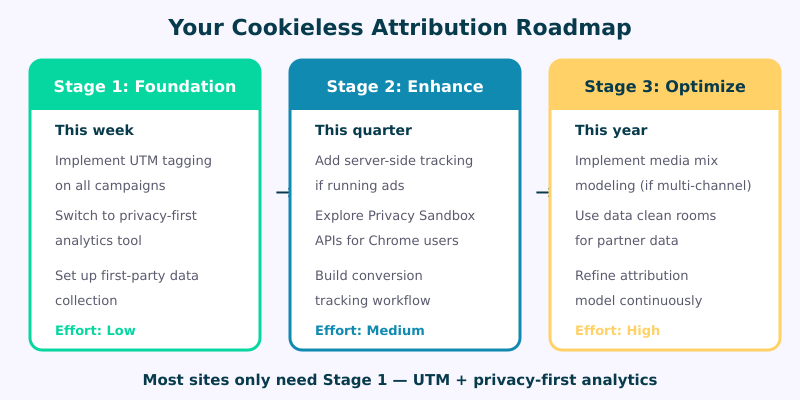
Start with what’s easiest: implement consistent UTM tagging across all campaigns (our free UTM parameter generator makes this easy) and switch to a privacy-focused analytics tool. Then build your first-party data capabilities — encourage account creation, improve your email capture, and connect your CRM to your analytics. If you run significant paid media, implement server-side tracking for your top platforms. Finally, once you have 6-12 months of clean data, explore Media Mix Modeling. The whole transition typically takes 3-6 months for a mid-size business.
Do I need consent for cookieless attribution methods?
It varies by method and jurisdiction. UTM parameters and server-side first-party analytics generally don’t require cookie consent because they don’t set tracking cookies. However, server-side tracking that sends data to third parties like Meta still requires consent under GDPR for the data sharing itself. MMM uses aggregate data and typically falls outside consent requirements. Privacy-Preserving APIs like the Attribution Reporting API are designed to not require individual consent. Always consult with a privacy professional for your specific situation.
What role does AI play in cookieless attribution?
AI and machine learning are increasingly central to filling attribution gaps. MMM tools like Meta’s Robyn use machine learning to decompose marketing effects from organic trends and seasonality. Google’s AI-powered conversion modeling estimates conversions that can’t be directly observed. Predictive analytics platforms use first-party data patterns to model likely attribution paths. The important thing is that these AI applications work on aggregate patterns, not individual tracking — they enhance privacy-friendly methods rather than replacing them.
Moving Forward Without Cookies
The death of cookie-based attribution feels like a crisis only if you were over-reliant on a fundamentally flawed system. The reality is that we now have better tools for understanding marketing effectiveness — tools that don’t require surveilling people across the internet.
My advice is practical: don’t try to replicate what cookies did. Instead, build an attribution framework designed for how the web works in 2026. Start with UTMs and first-party data. Add server-side tracking where needed. Validate with MMM. And stop trying to track individuals — track outcomes instead.
The marketers who thrive in this new landscape aren’t the ones clinging to user-level tracking. They’re the ones who realized that respecting privacy and measuring effectively aren’t opposing goals — they’re the same goal, approached from a foundation of trust rather than surveillance.