Last updated: February 2026
Every “Google Analytics alternatives” guide you’ve read was written by a company selling analytics. Plausible ranks Plausible first. Fathom ranks Fathom first. Usermaven ranks Usermaven first. You see the pattern.
This guide is different. I don’t sell analytics software. I help businesses choose and implement privacy-first measurement tools — and I’ve tested every tool on this list with real traffic. Here’s what I actually recommend, and why.
“Surveillance is the business model of the internet.”
— Bruce Schneier, security technologist, Harvard Berkman Klein Center fellow (SOURCE Boston, 2014)
Why Businesses Are Leaving Google Analytics
Google Analytics has been the default web analytics tool for almost two decades. But since 2022, the legal and practical ground beneath it has been crumbling.
It started with Austria’s data protection authority ruling that Google Analytics violates GDPR by transferring EU visitor data to US servers. France’s CNIL, Italy’s Garante, and Norway’s Datatilsynet quickly followed with similar decisions. These rulings emerged from 101 complaints filed by noyb, the privacy advocacy group led by Max Schrems.
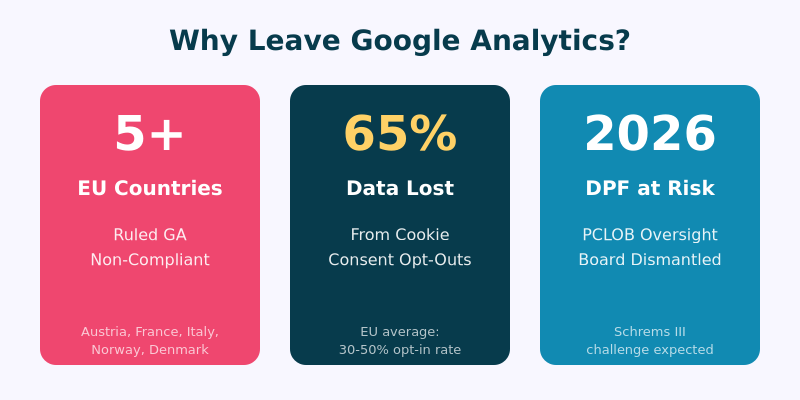
By 2024, Google Consent Mode v2 became mandatory in the EEA — meaning GA4 requires explicit cookie consent before it can collect any meaningful data.
That consent requirement created what I call the cookie banner tax. In the EU, only 25-45% of visitors accept cookies when a proper “Reject All” button is offered. Your GA4 dashboard? It’s showing you half the picture at best. Our Consent Impact Dashboard models this data loss for your specific traffic mix.
Add the instability of the EU-US Data Privacy Framework. In January 2025, the US administration fired three PCLOB board members, dismantling the oversight mechanism that EU regulators rely on. Privacy advocates are already preparing a “Schrems III” challenge that could invalidate the framework entirely.
The question isn’t whether to switch. It’s what to switch to.
What Makes Analytics “Privacy-First”?
Not every tool that claims to be “privacy-friendly” actually is. Here’s what to look for:
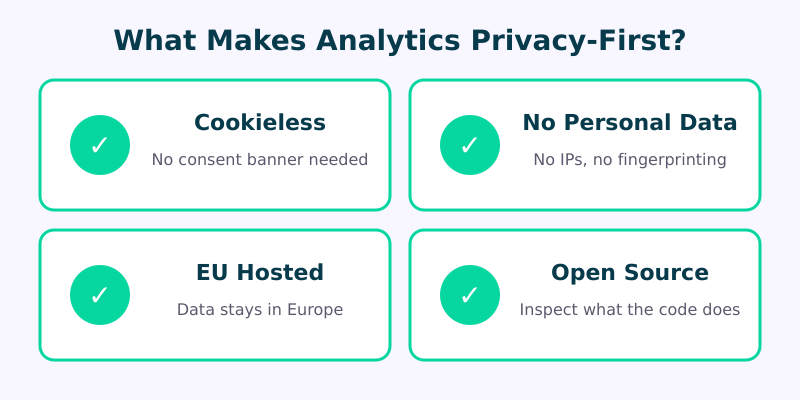
- Cookieless tracking — No cookies means no consent banner required under most privacy laws. Your analytics see 100% of traffic, not just the visitors who clicked “Accept.”
- No personal data collection — No IP addresses stored, no browser fingerprinting, no cross-site tracking. The tool measures aggregate behavior without identifying individuals.
- EU data hosting — Your visitor data stays on European servers, avoiding the legal uncertainty of transatlantic data transfers.
- Open source transparency — You can inspect exactly what the code does. No black boxes, no hidden trackers.
Privacy-First Analytics at a Glance
This table covers every tool in this guide. Pricing reflects February 2026.
✓ = Yes ⚙ = Configurable — = No CE = Community Edition CF = Cloudflare Workers WP = WordPress only Ent. = Enterprise only
The Privacy-First Essentials
These four tools represent the strongest options in the privacy-first analytics space. Each has a clear identity and a proven track record.
Plausible Analytics — The Lightweight Default
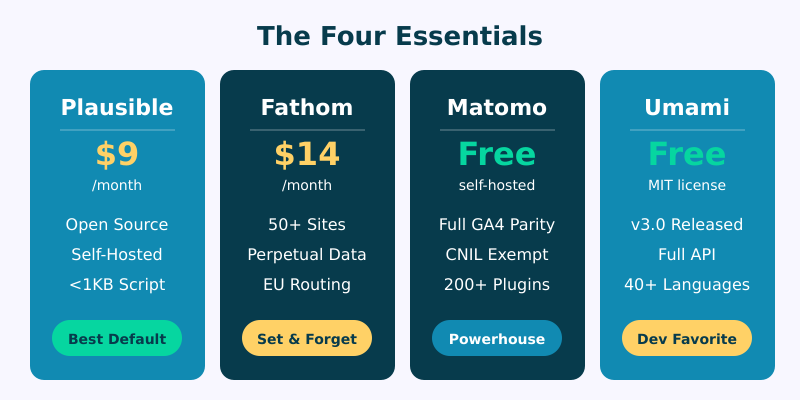
Plausible is what happens when you strip analytics down to what actually matters. The script is under 1KB — 75 times smaller than Google Analytics — meaning zero impact on your page speed. The dashboard loads in a single screen: top pages, referral sources, countries, devices, and goals. No training required.
Built and hosted in the EU, Plausible is cookieless by design and fully GDPR-compliant without consent banners. Cloud plans start at $9/month for 10K pageviews. For self-hosters, the Community Edition is free and open source (AGPL v3) — you run it on your own infrastructure via Docker and ClickHouse.
Recent updates added revenue tracking, scroll depth measurement, funnels (Business plan), and GA4 data import. If you want clean, simple, privacy-first analytics and don’t need session recordings or A/B testing, Plausible is my default recommendation.
Fathom Analytics — Premium “Set and Forget”
Fathom is the polished, premium choice. Starting at $15/month for 100K pageviews, it covers up to 50 websites on a single plan — which makes it excellent value for agencies. All plans include perpetual data retention (your data stays forever, not just 14 months like GA4).
Fathom automatically routes European traffic through EU infrastructure in Germany, no configuration needed. It’s cookieless, GDPR/CCPA/PECR compliant, and used by government agencies and Fortune 100 companies. The dashboard is clean and fast, with regex filters, custom events, and UTM campaign tracking built in.
The main limitation: Fathom is cloud-only (the old self-hosted Fathom Lite is no longer maintained) and doesn’t offer funnels or A/B testing. It’s designed for people who want to install a script, open a dashboard, and get answers — nothing more, nothing less.
Matomo — The Feature-Rich Powerhouse
Matomo is the closest thing to a full GA4 replacement in the privacy-first world. It offers heatmaps, session recordings, A/B testing, funnels, e-commerce tracking, a tag manager, form analytics, and a plugin marketplace with 200+ extensions.
Self-hosting is free with unlimited data. Cloud plans start at EUR 22/month for 50K hits. Crucially, Matomo is the only major tool approved by France’s CNIL for consent exemption — when configured in cookieless mode, French law allows you to use it without cookie banners.
The trade-off: steeper learning curve, expensive cloud at high volumes, and some advanced features require premium plugins on self-hosted. It’s right when you need feature depth or data sovereignty — overkill if all you want is a simple dashboard.
Umami — The Developer’s Self-Hosted Favorite
Umami hits the sweet spot between simplicity and self-hosting freedom. It’s MIT-licensed — the most permissive open-source license in this space — meaning you can fork, modify, and use it commercially without restrictions.
The v3.0 release brought a refreshed UI, journey reports, tracking links (like a self-hosted Bit.ly with analytics), tracking pixels for email, and universal filters. Self-hosting is free via Docker with PostgreSQL. Cloud starts at $9/month.
If you’re a developer who wants lightweight, privacy-first analytics on your own infrastructure with full API access, Umami is hard to beat.
Strong Contenders Worth Considering
Simple Analytics — The Minimalist’s Choice
Simple Analytics takes minimalism to its logical extreme. EU-based, EU-hosted, zero personal data by design. The dashboard is perhaps the most beginner-friendly in this guide. Plans start at $9/month (annual) with GA4 import. No self-hosting, but maximum simplicity with ironclad EU compliance.
Pirsch — Budget-Friendly, Made in Germany
Pirsch starts at just $6/month — the cheapest paid privacy option. Built and hosted in Germany with GDPR, CCPA, and Schrems II compliance. The Plus plan ($12/month) adds funnels, A/B testing, and white-labeling. Pirsch also imports data from Plausible, Fathom, and GA4.
PostHog — The All-in-One Product Suite
PostHog is a different animal. Web analytics, session replay, feature flags, A/B testing, surveys, error tracking, and a data warehouse — all in one. The free tier is extraordinary: 1M events/month. EU Cloud in Frankfurt. Requires configuration for cookieless mode, primarily for product teams.
Piwik PRO — Enterprise and Regulated Industries
Piwik PRO is built for organizations where compliance isn’t optional: healthcare (HIPAA), finance, government. Built-in Consent Manager, Tag Manager, and Customer Data Platform. The free Core plan was retired in 2026; Business now starts at €36/mo for up to 20 domains and 2M actions. EU data centers in Germany, Netherlands, and Sweden.
Swetrix — Open-Source Feature-Rich Newcomer
Swetrix combines web analytics with performance monitoring, error tracking, and revenue analytics (Stripe/Paddle). Open source under AGPL v3. Cloud from $19/month, self-hosted free. Hosted in Germany. Independent startup funded by subscribers only.
Indie and Free Options
These tools won’t replace GA4 for a Fortune 500, but they’re perfect for personal sites, blogs, and open-source projects.
OpenPanel — The most exciting newcomer. From $2.50/month, combining Mixpanel-style product analytics with Plausible-style simplicity. MIT-licensed, self-hostable, with funnels and multi-platform SDKs.
GoatCounter — Truly free, donation-supported, a 3.5KB script, and the highest accessibility standards in this space. Just clean pageview analytics.
Cabin — Carbon emissions tracking alongside privacy analytics. EU-hosted, cookieless, unlimited pageviews on all plans.
Independent Analytics — Runs entirely inside WordPress. Zero external requests, data in your own database. 100K+ active installs.
Counterscale — Runs on Cloudflare Workers. Deploy in 5 minutes, handle ~50K pageviews/day on Cloudflare’s free tier. MIT-licensed.
Which Tool Is Right for You?
Skip the feature matrices. Start with who you are and what you need:
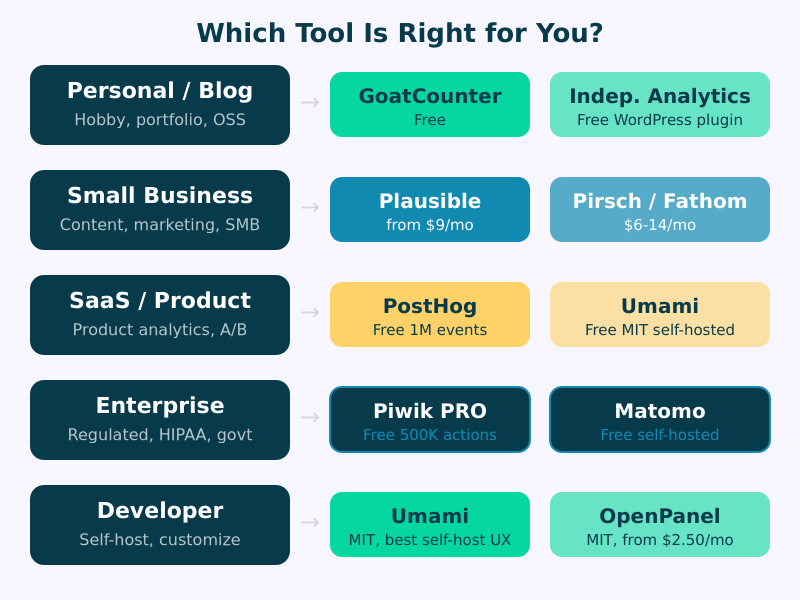
Personal blog or portfolio? GoatCounter (free) or Cabin (free). On WordPress? Independent Analytics takes 30 seconds.
Small business or content site? Plausible ($9/month) for the cleanest experience. Pirsch ($6/month) for tight budgets. Fathom ($15/month) for multi-site with perpetual data.
SaaS or product team? PostHog (free up to 1M events, includes session replay and feature flags) or OpenPanel ($2.50/month, Mixpanel-style with privacy).
Enterprise or regulated industry? Piwik PRO (HIPAA, built-in consent management) or Matomo self-hosted (CNIL-exempt, full data sovereignty).
Developer who wants to self-host? Umami (MIT, cleanest UX), Matomo (most features), or Plausible CE (lightweight). On Cloudflare? Counterscale in 5 minutes.
The Cookie Banner Tax: What You Lose by Keeping GA
Here’s the business case in one sentence: cookie-based analytics only see the visitors who consent.
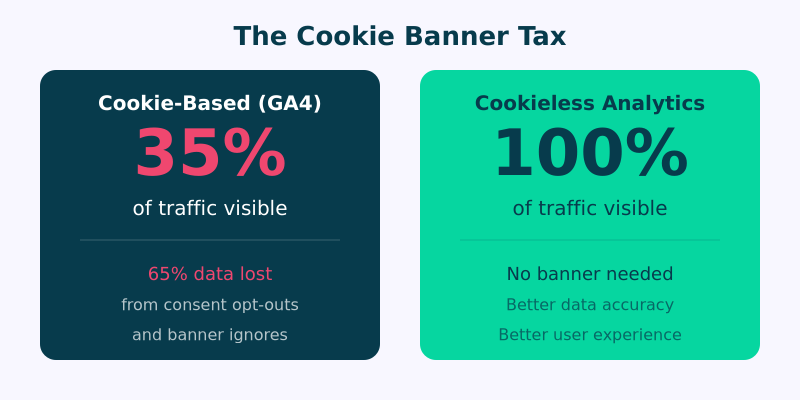
In the EU, cookie consent rates range from 25% to 45% when a proper “Reject All” button is offered (meta-analysis of 26 studies). That means GA4 is missing half to two-thirds of your actual traffic.
Beyond accuracy, cookie banners have measurable costs: UX degradation, increased bounce rates, development overhead for maintaining compliant implementations, and ongoing regulatory risk.
Cookieless analytics eliminate all of this. No banner, no data loss, no compliance anxiety. 100% traffic visibility with zero friction. For a deep dive into the legal landscape, see our Complete Guide to Privacy-Compliant Analytics. And if you want to understand where the entire industry is heading — AI-powered analytics, browser-level consent, cookieless attribution — read our Future of Web Analytics guide.
Frequently Asked Questions
What is the best free alternative to Google Analytics?
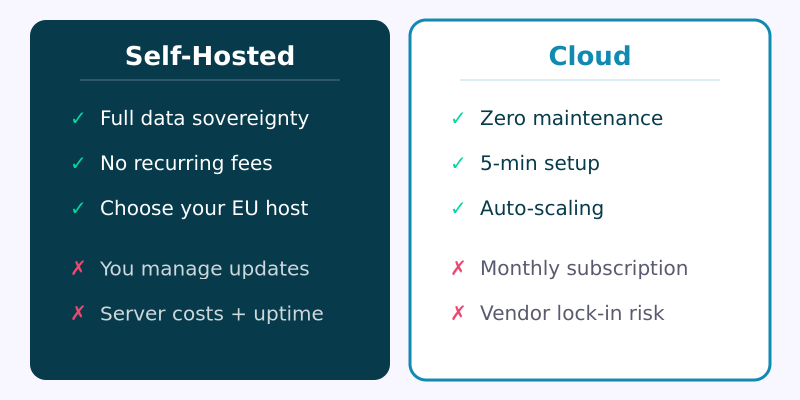
For self-hosting, Umami (MIT license) and Matomo (GPL v3) are the strongest free options with no limits. For hosted free tiers, PostHog offers 1M events/month, Piwik PRO Core gives 500K actions/month, and GoatCounter is entirely free. For WordPress, Independent Analytics is a free plugin with zero external dependencies.
Is Google Analytics GDPR compliant in 2026?
It’s complicated. Multiple EU DPAs (Austria, France, Italy) ruled GA non-compliant. The EU-US Data Privacy Framework currently allows transfers, but its future is uncertain after PCLOB was dismantled. Even with the DPF, GA4 requires cookie consent via Consent Mode v2 — resulting in 50-70% data loss.
Do I need a cookie consent banner for analytics?
Only if your analytics tool uses cookies or collects personal data. Cookieless tools like Plausible, Fathom, Simple Analytics, Pirsch, Umami, and GoatCounter don’t require consent banners under GDPR or the ePrivacy Directive. Matomo is specifically exempt when configured in cookieless mode with CNIL approval in France.
What is the most privacy-friendly analytics tool?
Plausible and Fathom are the gold standard. Both are cookieless, collect zero personal data, and are fully GDPR-compliant without consent. For maximum data sovereignty, Umami or Matomo self-hosted keep all data on your own infrastructure.
Can I self-host my own web analytics?
Yes. Top options: Umami (MIT, easiest setup), Plausible CE (AGPL, lightweight), Matomo (GPL, most features), OpenPanel (MIT, product analytics), and Swetrix (AGPL, includes error tracking). You get complete data ownership but handle maintenance yourself.
Is Plausible or Fathom better?
Plausible offers self-hosting (free CE), funnels, revenue tracking, and lower pricing ($9/month vs $14/month). Fathom offers perpetual data retention, 50-site plans, and a polished managed experience. Choose Plausible for self-hosting or advanced features; Fathom for simplicity and long-term data.
What is the best analytics plugin for WordPress?
Independent Analytics is simplest: free, data in your WP database, zero external requests. For more features, Matomo for WordPress gives full analytics inside WP. Both Plausible and Fathom have official WordPress plugins for lightweight external analytics.
Ready to make the switch? Start with any tool from the Essentials section — you can be up and running in under 10 minutes.
Vendor free tiers re-checked 13 August 2026.