This is part of our Google Analytics Alternatives Buyer’s Guide.
You want website analytics without spying on your visitors. Three tools dominate the privacy-friendly space: Plausible, Fathom, and Matomo. All three skip cookies, respect GDPR, and give you useful data. But they solve different problems for different people.
I’ve run all three on client sites over the past four years. Here’s what I’ve learned — no vendor bias, just real experience.
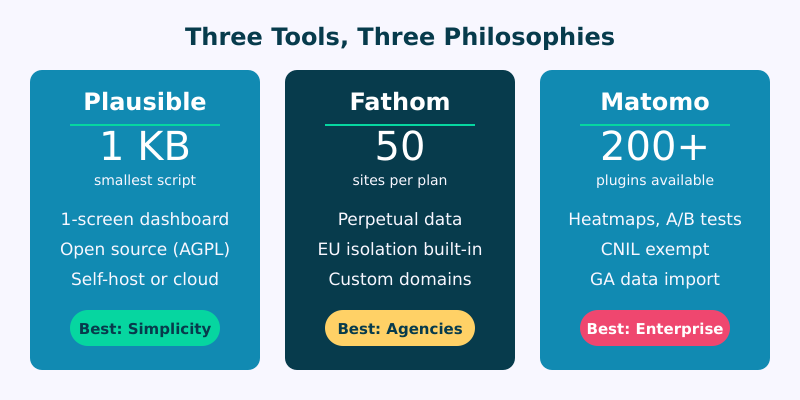
Quick Comparison
✓ = Yes ⚙ = Configurable — = No
Plausible Analytics — The Lightweight Default
Plausible is what analytics looks like when you strip away everything unnecessary. The entire dashboard fits on one screen. No nested menus, no training, no 47-page setup guide.
The tracking script is under 1 KB — 75 times smaller than Google Analytics. That’s not a marketing number; I’ve measured it. On a client’s Shopify store, switching from GA4 to Plausible improved their Largest Contentful Paint by 120ms.
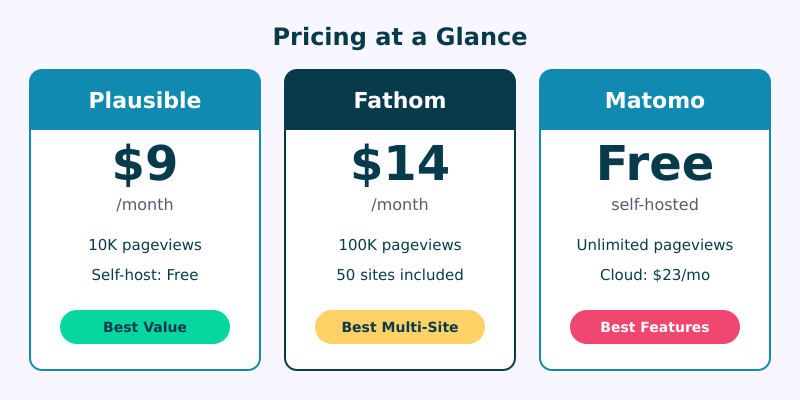
Plausible is fully open source (AGPL v3). You can self-host the Community Edition for free on your own server, or use the managed cloud starting at $9/month for 10K pageviews. Recent updates added revenue tracking, funnels (Business plan), scroll depth, and GA4 data import.
Strengths: Smallest script, simplest UI, open source, self-hosting option, lowest cloud price.
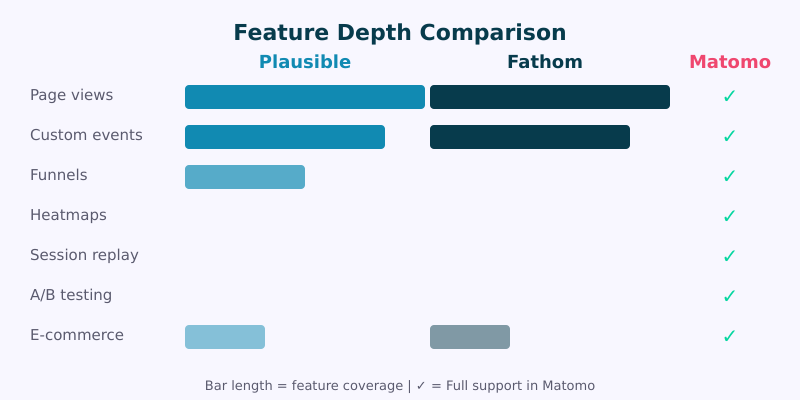
Limitations: No session recordings, no heatmaps, no A/B testing. Basic e-commerce tracking (revenue only).
Fathom Analytics — Premium “Set and Forget”
Fathom is the polished, commercial option. Not open source, not self-hostable — but exceptionally reliable. I’ve had clients running Fathom for two years without a single downtime incident.
Plans start at $14/month for 100K pageviews and cover up to 50 websites. That multi-site pricing makes Fathom the best value for agencies. All plans include perpetual data retention — your data stays forever, unlike GA4’s 14-month limit.
Fathom automatically routes European traffic through German infrastructure. No configuration needed — EU isolation is built in. Campaign attribution works seamlessly — just tag your links with UTM parameters and Fathom breaks down traffic by source, medium, and campaign. Their custom domain feature helps bypass ad blockers, and their bot filtering is aggressive and accurate.
Strengths: Multi-site pricing, perpetual data, excellent uptime, custom domains, strong bot filtering.
Limitations: Not open source, no self-hosting, no funnels, no session recordings. Higher starting price.
Matomo — The Analytics Powerhouse
Matomo (formerly Piwik) has been around since 2007. It’s the only privacy-friendly tool that comes close to GA4’s feature depth — and in some areas surpasses it.
The self-hosted version is completely free with no pageview limits. You get heatmaps, session recordings, A/B testing, funnels, cohorts, and full e-commerce tracking. The cloud version starts at $23/month for 50K hits.
Matomo is the only analytics tool with a CNIL exemption — France’s data protection authority has approved it for use without cookie consent when properly configured. It can also import historical GA data, making migration smoother.
Strengths: Deepest feature set, free self-hosted, CNIL consent exemption, GA data import, full e-commerce.
Limitations: Steeper learning curve, heavier script (22 KB), cloud version is pricier. Self-hosting requires server maintenance.
Head-to-Head: Dashboard Experience
Plausible wins on simplicity. One screen, no clicks. I show it to clients who have never used analytics before, and they understand it in 30 seconds.
Fathom is slightly more detailed — it shows more filtering options and allows regex-based custom grouping. Still clean, but there’s a bit more to learn.
Matomo has the full analytics dashboard experience. Navigation menus, sub-reports, date comparison, custom dashboards. If you’re coming from GA4, Matomo will feel familiar — but it can overwhelm first-time users.
Head-to-Head: Privacy & Compliance
All three are cookieless and GDPR-compliant without consent banners — use our Consent Logic Planner to see exactly which regions require consent for different tracking technologies. But the details differ:
- Plausible — no personal data collected, no consent needed. Period. The simplest compliance story.
- Fathom — same approach, with added EU data isolation through German infrastructure.
- Matomo — cookieless by default since version 4, but some features (like session recordings) do require cookies. The CNIL exemption only applies to the analytics module with specific configuration.
For organizations in regulated industries (healthcare, finance, government), Matomo self-hosted offers the strongest data sovereignty — the data never leaves your servers.
Which One Should You Pick?
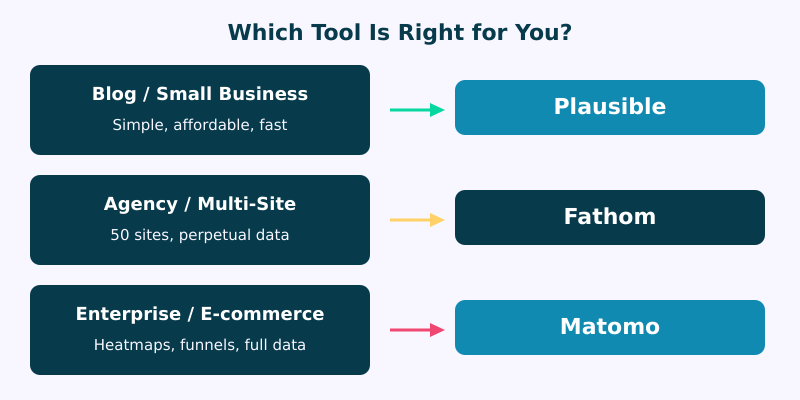
Choose Plausible if you want the simplest possible analytics. Best for blogs, content sites, SaaS marketing pages, and small businesses. If you’ve never set up analytics before, start with Plausible — it takes 10 minutes.
Choose Fathom if you manage multiple websites (the 50-site plan is unbeatable value), need perpetual data retention, or want a premium managed experience with zero maintenance.
Choose Matomo if you need advanced features — funnels, heatmaps, A/B testing, full e-commerce. Ideal for enterprises, regulated industries, and teams migrating from GA4 who need a similar feature set with full data ownership.
My Recommendation
For 80% of websites, Plausible is the right answer. It’s affordable, fast, and gets out of your way. I use it on most client sites and on my own projects.
For agencies managing client analytics, Fathom’s multi-site pricing makes it the clear choice. One $14/month plan covers everything.
For serious analytics needs, Matomo self-hosted is unmatched on value. Free, unlimited, feature-rich, and you own every byte of data.
All three respect your visitors’ privacy. You can’t go wrong — but one of them fits your situation better than the others.
Exploring more options? Our full Google Analytics alternatives guide covers 14 privacy-first tools.
FAQ
Is Plausible better than Fathom?
Plausible is cheaper ($9 vs $14/month), open source, and offers self-hosting. Fathom is better for agencies managing multiple sites (50-site plan) and offers perpetual data retention. Choose Plausible for simplicity and cost; Fathom for multi-site management.
Can Matomo replace Google Analytics completely?
Yes. Matomo is the closest privacy-friendly equivalent to GA4. It offers heatmaps, session recordings, A/B testing, funnels, and full e-commerce tracking. The self-hosted version is free with no data limits. It can even import your historical GA data.
Do these tools require cookie consent banners?
Plausible and Fathom are cookieless — no consent banner needed. Matomo is cookieless by default since version 4, but some premium features (session recordings) use cookies. France’s CNIL has specifically approved Matomo for consent-exempt use when properly configured.
Which is best for a WordPress site?
All three have WordPress plugins. Plausible is the lightest (under 1 KB script, zero page speed impact). For more features, Matomo for WordPress runs entirely inside your WP database with no external requests. See our Plausible setup guide for a step-by-step walkthrough.
Can I self-host Plausible or Matomo?
Yes. Plausible Community Edition (AGPL) and Matomo On-Premise (GPL) are both free to self-host. Plausible uses Docker + ClickHouse; Matomo uses PHP + MySQL. Fathom is cloud-only with no self-hosting option.